We believe that each room, building, environment, and piece of furniture, along with the character and individuality of the people who inhabit these spaces, can be brought forward through the creativity of the mind, the critical taste of the informed eye, and the craft of the skilled hand.
Tollgard Belgravia
Tollgard Chelsea
Tollgard Contracts
Ceccotti Collezioni
Design Centre
London, SW10 0XE

House of Finn Juhl
The one who was not a cabinetmaker. Juhl trained as an architect at the Royal Danish Academy, and in a generation where almost everyone came up through the workshop - Wegner, Mogensen, Kjærholm - that made him the outsider. He could not build what he drew. He had to find someone who could, and from 1936 that was the master cabinetmaker Niels Vodder. The distance between those two men is exactly where the work happens. Juhl drew shapes no trained maker would have proposed, because he did not know they were unreasonable, and Vodder found ways to build them.
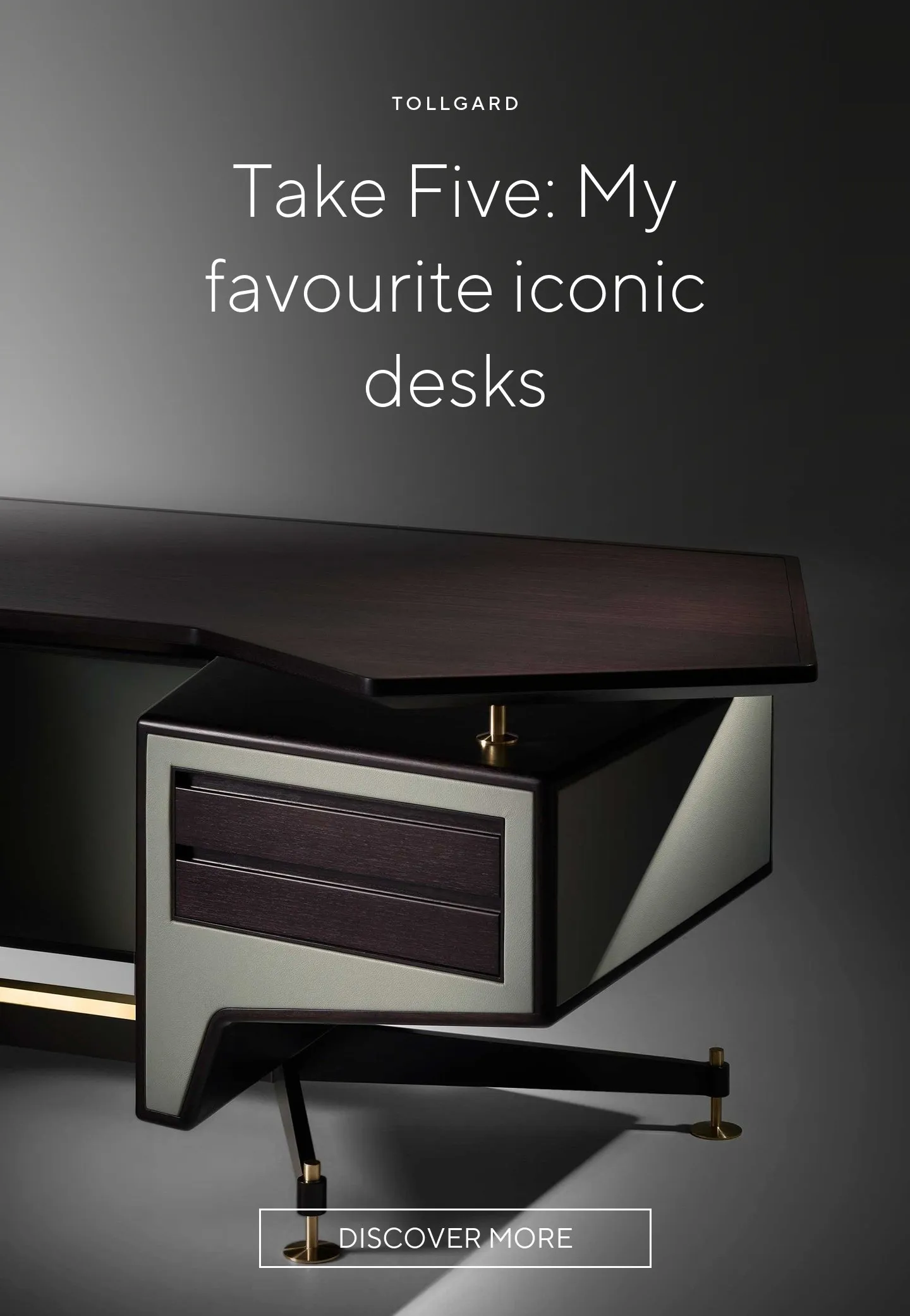
The Chieftain, shown at the Cabinetmakers’ Guild Exhibition in Copenhagen in 1949, is that argument at its clearest. The seat and the back sit clear of the frame rather than inside it, so the leather reads as something laid across the structure rather than packed into it. Juhl was looking at Arp and at Henry Moore, and it shows. No other chair of that decade looks like it, and the reason is that he was drawing rather than making.
Juhl wrote that an architect “should strive for unity but not uniformity, and establish a complete thought process behind everything”. This for me translates into the ‘red thread’ that we weave through our own projects: a unifying design narrative that runs through each project, each piece of furniture that we design, and against which we weigh every decision.

PP Møbler
The workshop that was given the difficult jobs. PP Møbler was founded in Allerød, north of Copenhagen, in 1953 by the brothers Lars Peder and Ejnar Pedersen, and is still run by the family in the third generation. My reading of the Wegner relationship is simple: he sent them the designs that were hardest to make and let the straightforward ones go elsewhere. It began exactly that way. Their first work for Wegner was as a subcontractor to AP Stolen, building the frame of the Papa Bear - the part of the chair nobody else wanted. When the Johannes Hansen workshop failed at the start of the 1990s, PP took on that collection too, the Round Chair among it, rather than watch it disappear.
Which is why the catalogue reads the way it does. It is not a selection of Wegner’s best designs. It is a selection of his most demanding ones, and those turn out to be very nearly the same list.
The Papa Bear is from 1950 and is the friendliest difficult chair ever made. It is put together like upholstered engineering, and then the arms end in two small exposed teak paws. That detail names the chair, but it is there for a reason: a hand needs somewhere to land that is not fabric. Sit in one and you understand why a family keeps it for fifty years and re-covers it twice.

Malte Gormsen
The classicist working now. Malte Gormsen trained as an apprentice cabinetmaker, first with a small family workshop in Scotland and then with Niels Roth Andersen in Denmark, where the job was making Finn Juhl and Vestergaard Jensen pieces to the original drawings. He learned the trade with his hands inside the furniture at the top of this list, which is not a coincidence I can improve on. He set up his own workshop in 1999; it sits in Herlev, outside Copenhagen.
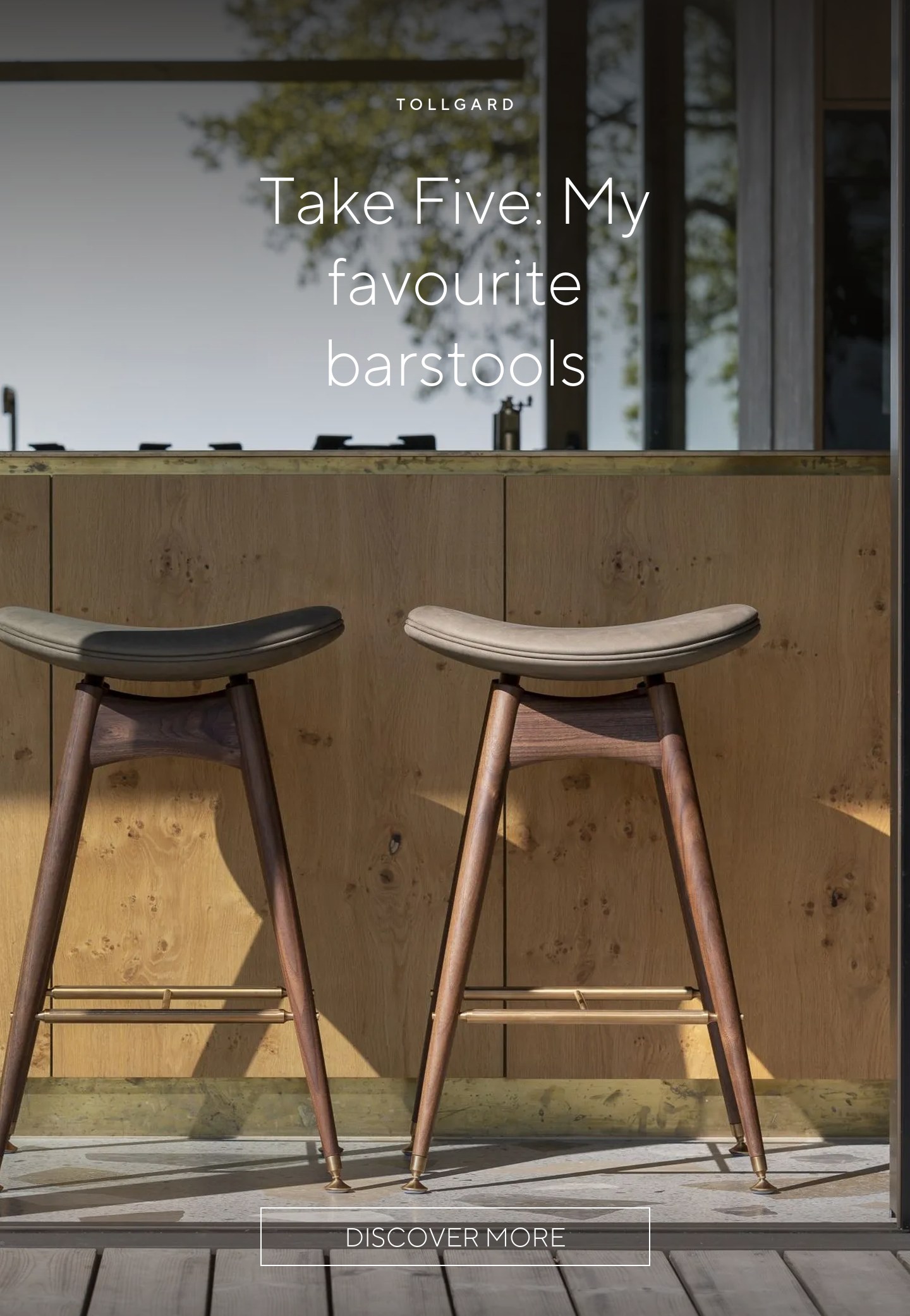
He built the business on interiors rather than on a collection - Noma, Geranium, Geist, 108 - and the collection came afterwards, developed over a decade with Space Copenhagen. The MG106 is a dining armchair in solid oak and paper cord, most of it worked by hand. Paper cord is an honest material to choose, because it cannot be faked and it shows every hour that went into it. What I admire is the restraint. There is nothing in the chair that is there to be noticed.

Vipp
From a bin to a kitchen, and then to a hotel. In 1939 a metalworker in Randers called Holger Nielsen made a pedal bin for his wife Marie’s hairdressing salon. He made three. The name is the sound the lid makes. That bin is now in the collection of the Museum of Modern Art in New York, which is a considerable outcome for a favour done for one’s wife.
His daughter Jette Egelund took the company on in 1992 and moved the object out of the salon and into the home. Her son Kasper runs it now, the third generation. The kitchen followed in the mid-2000s, then the bathroom, then lighting and furniture, and then, with the logic of a company that has never quite believed in categories, a building.
The 453 is Morten Bo Jensen’s swivel dining chair, a polished aluminium frame carrying a leather shell. It is the piece that shows what Vipp actually is. Everyone else in this list began with wood; Vipp began with metal and a mechanism, and eighty-odd years later it still designs like an engineering company that happens to make beautiful things.

Overgaard & Dyrman
The newest name here, and the one I would watch. Jasper Overgaard and Christian Dyrman met as students at Aalborg, went on to the Royal Danish Academy, and founded the studio together in 2013, before they had finished. Christian trained as a blacksmith and Jasper as a leather craftsman, which is the whole company explained in a single line: steel and hide, made by the two people who know those materials best.
The Circle arrived in 2019. Its base is drawn from a drafting compass - a trestle that opens rather than four legs that stand — and the chairs are numbered and made to order. The joinery is cut on modern machinery and finished by hand, and the studio makes no apology for either half of that. Nor should it. The workshops of the 1950s used every tool available to them; the romance about hand tools came later, and mostly from people who were not doing the work.

What the five have in common
An architect, a family workshop, a cabinetmaker, a metal company and two graduates with a forge between them. On the face of it they share very little. What connects them is that in every case the making came first and the style came out of it. None of these pieces is a drawn shape handed to a factory to solve. The Chieftain exists because Vodder could build it. The Papa Bear exists because someone would take on the frame. The Circle looks the way it does because one of the founders can weld and the other can stitch.
That is the Danish lesson, and it is still being taught. Malte Gormsen learned it from a man who made Finn Juhl’s furniture. Overgaard & Dyrman learned it by picking up the tools themselves. Between them, they are carrying on something that began at the Guild exhibitions seventy-five years ago, and they are doing it without nostalgia, which is the only way it works.
Five Danish answers, then, from one Swede who has stopped pretending to be impartial about it.

Van Rossum
The one that taught me patience. Van Rossum has been making by hand in its Dutch workshop since 1978, in French oak, and the timber is rested for years before anyone is allowed near it with a tool - first in the open, then in climate-controlled chambers until the moisture has settled where it needs to be. That sounds like housekeeping. It is actually the whole product. Oak that has not been given its time will move in a London flat with underfloor heating, and no finish will rescue it. They are also the best I know at end grain, cutting across the trunk so the growth rings read as the surface itself.

Ceccotti Collezioni
The one where wood behaves like a drawn line. Ceccotti works out of Cascina, near Pisa, and has been at it for some sixty years, turning solid timber into shapes that look sketched rather than cut. The tapers, the splayed legs, the way a back rail curves away from you - none of it is achievable in anything but solid wood, and very little of it is achievable by machine alone. I should declare the closest interest of all here: we hold Ceccotti for the UK and run their London showroom. I would still put them first.

Riva 1920
The one with the longest memory. Founded in Cantù, in the Brianza, in 1920 and now run by the fourth generation of the family, Riva passed its centenary before most brands manage a rebrand. What I admire most is where the timber comes from. Alongside wood from managed cuts, they work in ancient Kauri raised out of New Zealand swamps, in Lebanese cedar, and in briccole - the oak mooring posts pulled from the Venice lagoon when they are replaced, still scarred by the water. Finished in natural waxes and oils and nothing else. A table that spent its first life as a navigation post in Venice carries a story no showroom needs to invent.

Porada
The one that made me look properly at walnut. Porada was established in 1968 in Cabiate, near Como, with a chair-making tradition in the family that goes back to the 1940s, and canaletta walnut runs through the collection like a signature. Their strength is joinery you can read: the turned leg, the curve where two solid sections meet, proportions worked out in timber rather than imposed on it. If a client wants to understand why solid wood costs what it does, I put their hand on a Porada table edge.

Jeroen de Ruddere
The newest name here, and the only one who does not make furniture. De Ruddere is a Belgian maker of sculptural lighting turned from solid oak, walnut and mahogany - floor and table pieces where the timber is the object itself rather than a stand for a shade. He describes what he is after as ‘sculptural lighting that brings presence into a space: timeless in character, defined by architectural balance and an instinctive respect for natural materials’. He belongs on this list because his lamps read as well switched off as lit, which is as close to a definition of functional sculpture as I can give. We took him on this year, and I suspect he will be with us for a long time.

What the five have in common
In every case, solid wood is a decision rather than a finish. It costs more, it takes longer, it limits what can be drawn, and it obliges the maker to understand a material that was alive and still behaves as though it might be. What you get back is a piece that ages instead of degrading, and that can be repaired rather than replaced.
It is also the clearest argument I know for buying slowly. A veneered carcass has a lifespan; a solid one has a history.
With a new culture of sustainability slowly moving through all creative industries, the idea of looking hard for an heirloom piece that passes down through generations holds a lot of value. We look hard and buy once.
- Staffan Tollgård, Design Hunter, 2019
These five are what that principle looks like once someone has made it.

Wood. Older Than Architecture
Join us at theTollgard Showroom for Wood, Older Than Architecture - a conversation exploring the enduring language of wood indesign, with product designers Jeroen De Ruddere, Staffan Tollgård and FilippoCastellani, hosted by Pip Rich, Executive Editor of Livingetc.
Date: Wednesday 16th September, 4.30pm
Location: Tollgard Showroom, Unit 115, Chelsea Harbour Design Centre, London SW10 0XE
Please email rsvp@tollgard.com to confirm attendance.

Riva1920
Suiseki (水石) translates as "water stone" - the Japanese art of appreciating a naturally formed stone for the landscape it evokes, held in miniature and contemplated for tranquillity and longevity. Offered as a low table, a console and a dining table, the Suiseki collection moves Riva1920's language toward something more sculptural and fluid. Sharp edges are eased into organic shape. Monolithic, soft, harmonious.

Heiko 平衡) means balance and equilibrium. The Heiko dining chair is built around exactly that: structure and aesthetics in quiet dialogue. Sculptural and iconic, it is also grounded and refined, holding visual lightness alongside a chair that is genuinely comfortable to sit in.

De Castelli
Few makers understand metal the way De Castelli does. From their workshops in the Veneto, the house has spent four generations turning brass, copper and steel into surfaces with memory - oxidised, hand-finished, warm rather than cold. Two new pieces bring that craft into the collection.
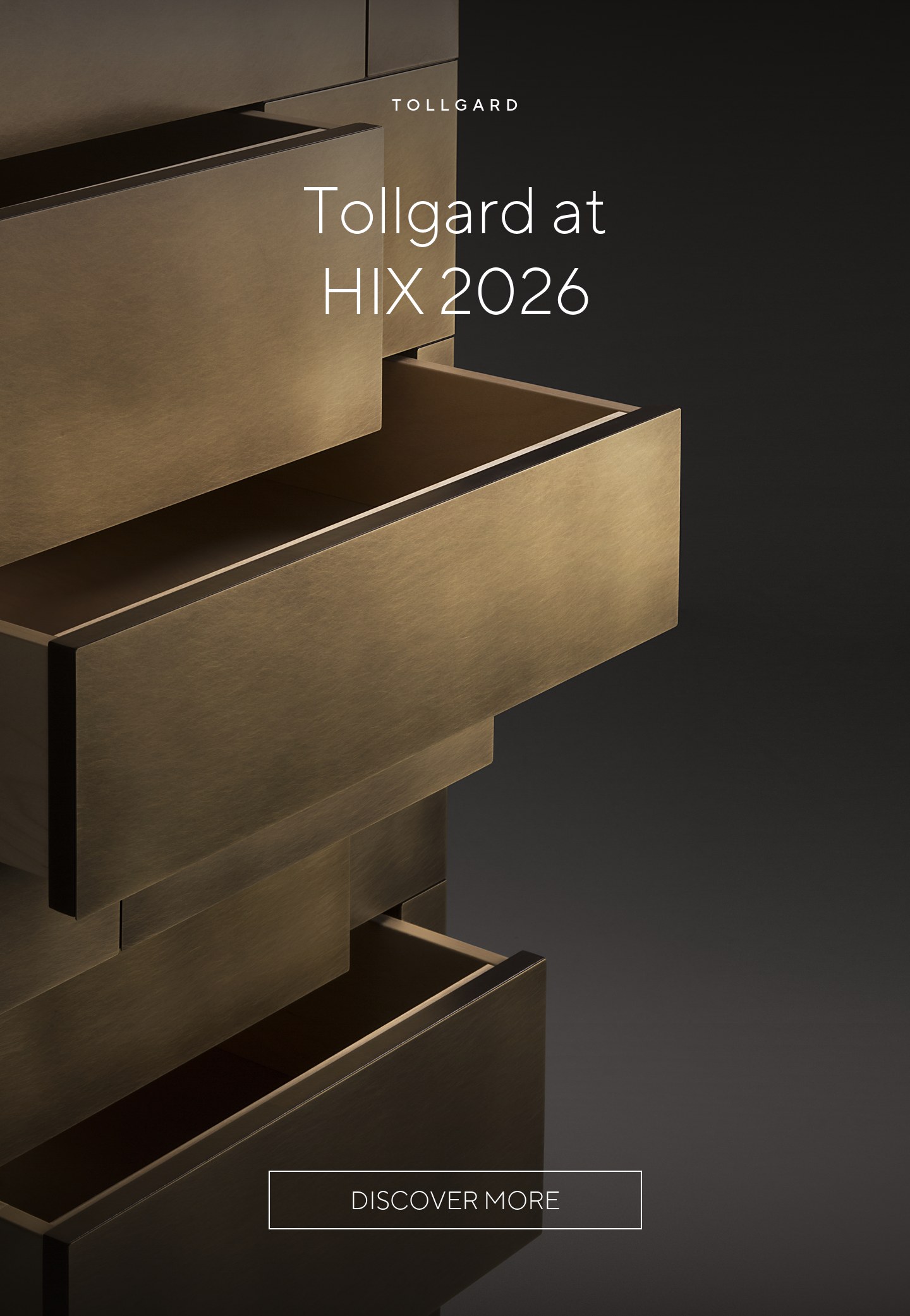
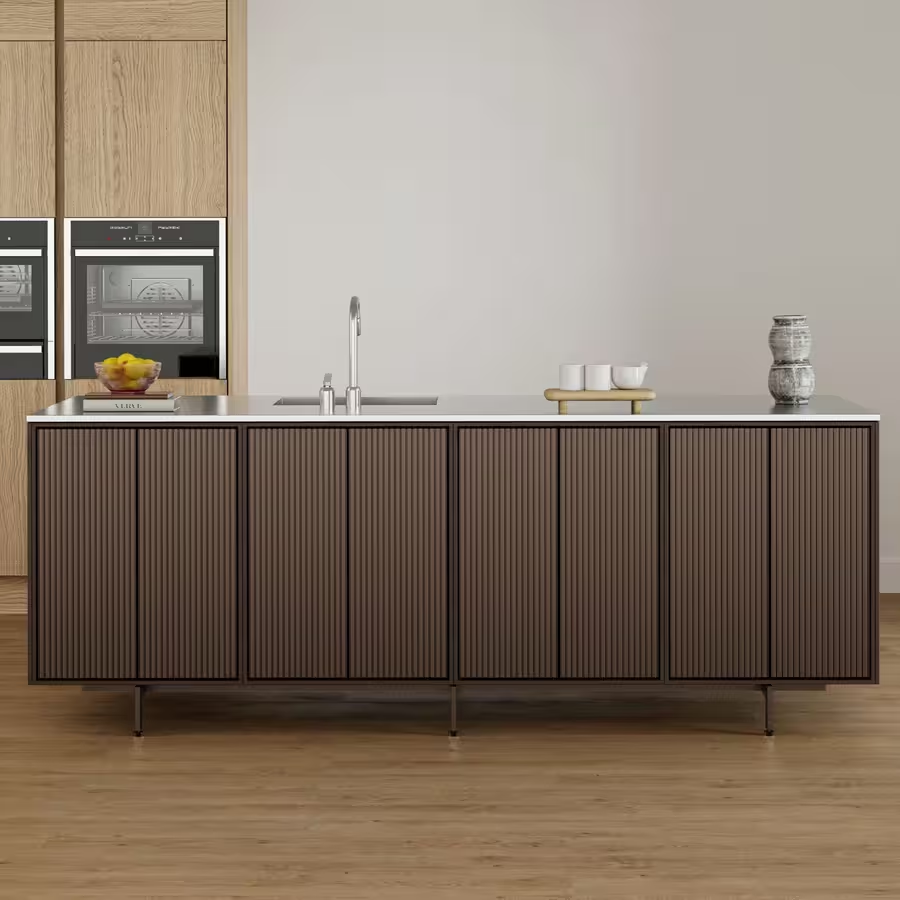
Francesco Forcellini's Dorica sideboard lays the language of a classical column on its side: clad in metal, its front runs in vertical concave flutes that read as a quiet relief, opening on a polished steel interior. Adele Martelli's Light&Shade wall light sets two overlapping metal discs one before the other, the light glowing from the perimeter and the gap between -the metal doing the work of a shade. One grounded, one luminous; both unmistakably De Castelli.

Jeroen De Ruddere
Belgian designer Jeroen de Ruddere rests a softly diffused light on solid, turned wood, with his FL4 and FL5 floor lamps. The FL5 is a fitting close to the story. Its silhouette is drawn from a tree trunk: a solid, tapering wooden base in oak, mahogany or American walnut, carrying a softly diffusing fabric shade. Handmade and dimmable, it is architectural in presence and gentle in the light it gives - solidity and softness, in a single object.

Bieke Casteleyn
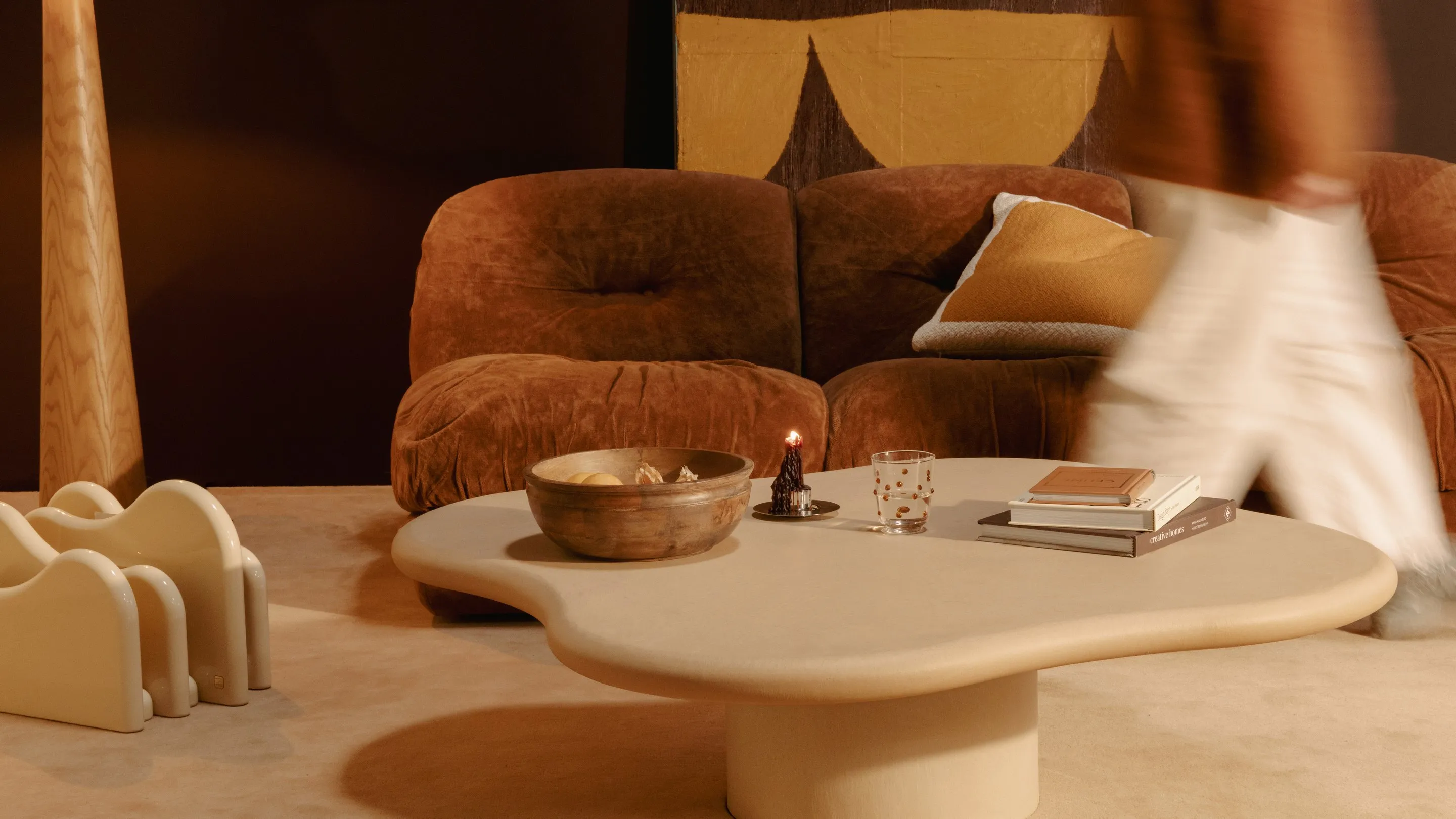
Some pieces arrive with noise; the Clover settles. Hand-built in troweled cement stuc - each one signed, numbered and unique - its soft four-lobed top reads like a cloud at rest on a single rounded plinth. Matt, tactile and quietly warm, it comes in a range of powdery tones, with an Edged option that traces the silhouette in natural stone or afrormosia wood. Two sizes, custom height on request. Familiar in feeling, new in form.

Ceccotti Collezioni
Alongside the shared stand, Tollgard brings forward five new pieces from Ceccotti Collezioni, the Italian house at its Centre Dome showroom. The standout is the Captain Hook wall clock by Guglielmo Ulrich - a piece of design archaeology recreated from a single archival photograph of his 1940s original. A perpendicular beam in solid American walnut holds a brass dial, its numerals enamelled by hand, hands and fixings in burnished brass. Part of Ceccotti's Masters Tribute, it honours the overlooked design objects of the last century - the solid, softened, in its most literal form.

One idea, several houses
From Italy to the Netherlands and Belgium, Focus 2026 makes the case for a single thread running through very different materials and makers. It is the same instinct Tollgard brings to every project: finding the röda tråden, the creative DNA, at the point where environment, architecture and identity meet.

Vipp
One of the standout installations from the fair was at the Vipp Garage, where the Barcelona-based studio Mesura transformed the space into an ephemeral guest house. A steel framework wrapped entirely in a vibrant plaid textile extended from walls and furniture into the courtyard, creating an immersive environment that announced itself before visitors even stepped inside.
At its centre sat a conversation pit formed from modular Loft sofa sections, reinforcing the studio's exploration of home as a shared experience. The installation was accompanied by a limited-edition Vipp x Mesura Swivel chair, developed specifically for the project and carrying the distinctive material language of the installation beyond the three-day event.

Alongside the installation, Vipp showed the Swivel chair in its two newest forms, models **454** and **455**. Both bring a higher backrest and a more spacious seat over the original, developed for long days at a desk or in a meeting - the 454 sits 61.5cm wide, with a 50cm seat depth, on a polished aluminium base available with castors or gliders, upholstered in aniline leather (camel, black and a bosco green among the finishes) or fabric, with elastic webbing beneath for give.
The 455 reads as the more considered variant of the same family. Both are intended to pair with Vipp's Studio Desk.

Vipp also previewed a new, larger desk and two new striking dining tables.

Finn Juhl
The home of Finn Juhl is its own argument for why thoughtful design matters. Walking through the rooms, you are reminded that Juhl never viewed furniture as simply functional objects. Instead, he saw them as part of a larger conversation about how we live, move, gather, and find comfort in our surroundings. Every room feels carefully considered yet deeply personal, revealing a designer who understood that the best interiors are not staged compositions but lived environments.
At the Finn Juhl showroom, a new silver cabinet was introduced - a piece very much in the Heirloom register, made to be kept and handed on.

Formakivet
At their Nordhavn showroom, FORMARKIVET presented New Dualism - an exhibition that felt like a precise statement of intent. The Copenhagen design house has always worked in productive tension: industrial materials held to a refined standard, classic forms recast in contemporary language. That contradiction was most legible in the Cubio collection, which grew again this year with the addition of a bench. Cast aluminium, offered in raw or semi-gloss light beige, each bench develops its own patina over time - the brand treats the micro-scratches and surface variations as part of the material's character rather than something to be corrected.
Alongside Cubio, the Ion upholstered seating was shown in full. Dining chairs and armchairs in fabric families ranging from cotton chenille to wool bouclé, and the Marmacén home scent collection, a fragrance range drawing on the woody warmth of oud and benzoin with top notes of frankincense and pine, lent the space an atmosphere that felt imoressive and considered.

PP Møbler
During 3daysofdesign, PP Møbler invited us inside the Flagship Store to mark two significant milestones. The Circle Chair celebrates 40 years, presented with a dedicated focus on its demanding construction and refined details.
At the same time, the Papa Bear Chair marks its 75-year anniversary, shown in special variations and with new additions to the collection. Together, they framed an exhibition centred on material understanding, precision and the ongoing work in the workshop.

Malte Gormeson
At the Cabinetmakers Gallery in The Conary on Dronningens Tværgade, Malte Gormsen presented new work from the Herlev workshop, combining traditional cabinetmaking with contemporary production techniques. The result was a collection defined by precision, material quality, and understated craftsmanship.
Three pieces stood out. The Abar stool from the Skt. Annæ series by Space Copenhagen brought a sculptural simplicity that highlighted the beauty of the materials. The Trapeza chair by Christian+Jade offered a clean, architectural presence with carefully considered proportions. A taller version of the MG406 stool by Norm Architects completed the trio, extending the versatility of the original design while retaining its refined character.

Anour
At its showroom on Bredgade, ANOUR used this year's festival to deepen a single idea: light treated as a material rather than a fitting. The PARS series was the anchor - a modular system in natural onyx, each piece carrying its own veins and tones, paired with refined brass so the stone seems to hold the light as much as pass it on.

A-N-D Lighting
One of the most considered presentations this year came from Vancouver-based studio A-N-D, which used 3 Days of Design to open its permanent European home - a former commercial printing press in Copenhagen's Latin Quarter.
The three-floor space, titled North Quarters, felt more like an inhabited interior than a trade show stand: on the ground floor, pendants from the Contour and Pebble collections hung in a necklace-like formation above a 16-foot dining table by Canadian designer Christian Woo; in the basement, the original industrial surfaces were left largely intact, letting floor lamps and sconces speak quietly against raw walls; upstairs, rows of Column floor lamps anchored a contemplative room with an audio installation built around sound waves.
Founded by designers Lukas Peet and Caine Heintzman, A-N-D has always approached lighting as a long-term proposition - every LED across their range is replaceable, and the studio designs for a lifespan of 20 to 30 years. It's the brand we return to when a project calls for something that earns its place in a room rather than announces it.


The Craft of Permanence: Wood, Bone & the Nordic Tradition
House of Finn Juhl
A pointed choice this year: Explore a program centered around heritage, materiality, and craftsmanship. At their flagship showroom on Gothersgade, the exhibition The Deviation is in the Detail, curated by Mentze Ottenstein, unfolds from Finn Juhl's belief that true character emerges through nuance and attention to detail. In collaboration with Sea New York, embroidered textiles introduce a new perspective on Finn Juhl's iconic furniture. At Edition Copenhagen in Christianshavn, the installation The Workshop offers a closer look at the making of Finn Juhl's furniture, as the entire space is transformed into a living production site.
The Deviation is in the Detail
Location: House of Finn Juhl, Flagship Showroom, Gothersgade 9, Copenhagen
The Workshop
Location: Edition Copenhagen, Strandgade 66, Copenhagen

PP Møbler
A double anniversary year for the Wegner workshop: forty years of the Circle Chair, seventy-five of the Papa Bear and the Flag Halyard. The newly redesigned flagship turns into a working space for the duration - cabinetmaker and weaver in residence, the Circle Chair shown stage by stage from raw timber to woven seat. The most significant moment is the first production, by invitation, of the pp101: a 1955 Hans J. Wegner side-chair brought into the catalogue for the first time, drawn straight from the archive in oak or beech with a hand-woven linen webbing seat.
PP Møbler Flagship Store, Bryggernes Plads 11, 1799 Copenhagen V. 10–12 June, 10.00–18.00.

Gemla
Sweden's oldest furniture-maker, established in 1861, still steam-bending wood in Diö, joins the Frederiksstaden district this year. The Gemla story is one of long, patient craft: bentwood chairs that have evolved across generations through quiet collaboration with designers including Sami Kallio, Norm Architects and Färg & Blanche.
Residence of the Finnish Ambassador, Grønningen 11, CPH.

The New Originals: Contemporary Makers Redefining the Object
Meridiani
Meridiani returns to Copenhagen on two fronts. The Meridiani Point at Rue Verte holds the brand's current collections in central Copenhagen, while Meridiani House - Christine Callsen's five-room apartment on Strandvejen in Hellerup - continues as a fully furnished residential setting, the kind of slow, lived-in showroom we always recommend visitors make the journey north for. Their reading of Make This Moment Matter leans, as ever, on materials and atmosphere.
Meridiani Point at Rue Verte, Ny Østergade 11, 1101 Copenhagen K. Meridiani House, Strandvejen 163, 2900 Hellerup. 10–12 June, daily.

Vipp
Vipp return to 3days, where Barcelona-based architecture and design studio @mesura.eu reimagines the idea of a guesthouse. Typically a place of retreat, it becomes something else entirely. At Vipp’s Copenhagen campus, the Barcelona-based architecture and design studio presents a vibrant new take on the Vipp guesthouse - transforming it into a bold, immersive experience.
Vipp HQ, Snorresgade 22, 2300 Copenhagen S. 10–12 June, daily.

Overgaard & Dyrman
Jasper Overgaard trained as a leather craftsman. Christian Dyrman trained as a blacksmith. They met at the Royal Danish Academy of Fine Arts and in 2013 founded a studio that fuses these two ancient crafts into furniture for the present. Every O&D piece is made to order, individually stamped and numbered. Their Wire Collection - structural steel and aniline-dyed leather - caused an immediate sensation at Imm Cologne. The Circle Chair followed, its compass-inspired backrest designed to be observed from every angle. Furniture conceived as both functional object and three-dimensional art.
Studio & Showroom (by appointment) Frederiksgade 1, 4th floor, 1265 Copenhagen, Kongens Nytorv District

Van Rossum
Founded in a Dutch workshop in 1978, Van Rossum has spent nearly five decades perfecting what solid wood can be. Their sober, timeless aesthetic is built on certified oaks and European hardwoods, handcrafted by artisans who regard each piece as both functional object and quiet sculpture. At 3 Days of Design, the brand habitually expands its frame - expect not just dining tables and chairs, but new moves into lighting, rugs and accessories, each material conversation anchored in the same measured, gallery-like restraint that defines their scenography.
Nyhavn 71, 1051 Copenhagen, Wednesday 10 June to friday 12 June 2026

FORMARKIVET
A new form for classic. Formarkivet are exhibiting at their Nordhavn showroom during 3daysofdesign. New Dualism, their 2026 exhibition, holds that tension beautifully: classic principles and modern sensibilities, each pushing against the other until something original emerges. One of the ones to watch.
Århusgade 128D, 1st–2nd Floor, 2150 Copenhagen, in the Nordhavn district.

Malte Gormeson
The Herlev cabinetmaker once again decamps to its Cabinetmakers Gallery at The Conary in Frederiksstaden - the kind of space where you can read the joinery from across the room. The Malte Gormsen Kollektion sits alongside pieces by Space Copenhagen, Norm Architects, Nanna Ditzel and Christian+Jade, all built in the Herlev workshop. The MG Sofa by Space Copenhagen has been shortlisted for Furniture of the Year, and is worth sitting with quietly.
Malte Gormsen Cabinetmakers Gallery, The Conary, Dronningens Tværgade 26, 1302 Copenhagen K. 10–12 June, daily.

The Atmosphere Makers: Light, Crystal & the Presence of a Room
Jeroen De Ruddere
Belgian designer who shapes sculptural lighting from oak, walnut, mahogany and solid bronze is exhibiting Meet the Family, presenting the complete collection of his handcrafted wooden objects and lamps under one roof for the first time. A quiet, architectural body of work; very much in the conversation we like to have.
Jeroen De Ruddere, Frederiksgade 1, 3rd floor, 1265 Copenhagen K. 10–12 June, daily.

Anour
Anour is Farsi for light. It is also the name that architect Arash Nourinejad gave to his Copenhagen lighting studio in 2007, and the word perfectly captures what his lamps do: they make light feel like a material decision rather than an afterthought. Working with some of the last remaining braziers in Denmark - artisans who keep a dying craft alive - Anour produces handcrafted pendants, floor lamps and wall lights in brass, copper and blued steel, each individually surface-treated using organic oxidising techniques. The I-MODEL, their first and most iconic lamp, has grown into a whole family. Their new PARS collection introduces modular onyx, where natural stone veining means no two pieces are identical. Design rooted in the past, made by hand, built for the future.
28A Gallery (with Kolon & Norm Architects) Bredgade 28A, 1260 Copenhagen K

A-N-D
A real moment for the Vancouver studio: A-N-D opens its first permanent showroom outside Canada, in a listed Copenhagen courtyard building that once printed paper. Three floors, three functions, and three new lighting series from Lukas Peet and Caine Heintzman - shown alongside earlier pieces in a sensory presentation that suits the brand's instinct for light as material rather than fixture. We've been following A-N-D quietly for a few years; this feels like the right moment to introduce them properly to our European audience.
A-N-D Copenhagen, Studiestræde 34, 1455 Copenhagen K. 10–12 June, daily. Opening party Tuesday 9 June, evening.

Bomma
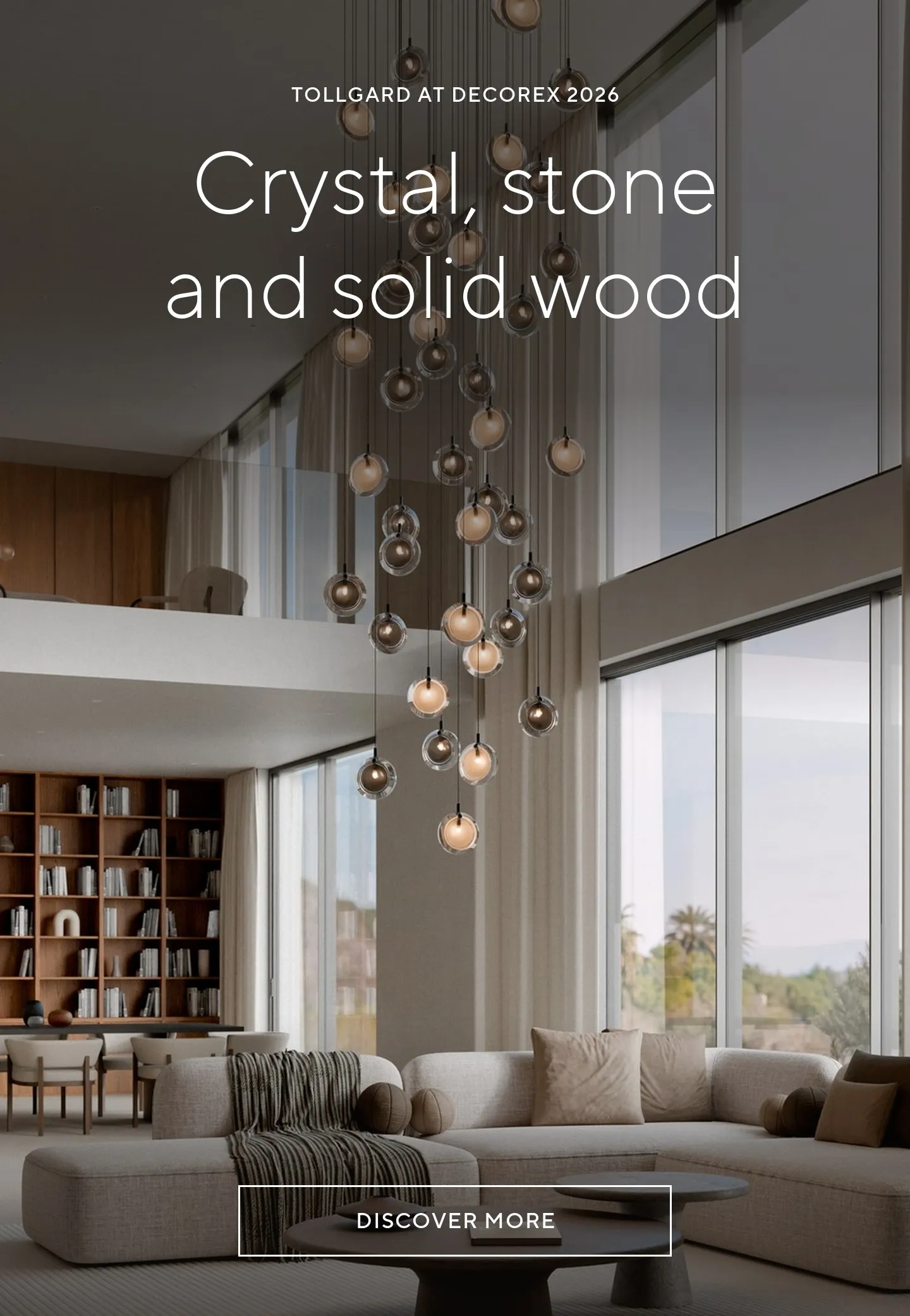
Bomma fills Copenhagen's newly reopened historic Court Theatre (Hofteatret) with their Fragments of Light installation - handblown crystal chandeliers accompanied by live performances every 30 minutes. A spectacular venue for spectacular lighting. Christiansborg / Rosengård District.
Hofteatret (Court Theatre)


A decade-long treasure hunt through Norway’s mid-century archive, now made afresh in Stavanger.
Founded in2016, Eikund has built its reputation by rediscovering forgotten Norwegian designs from the post-war golden age and putting them back into production —properly, with the original makers’ families where possible. Expect solid oak,naturally tanned leather and Norwegian wool, in shapes that have aged better than most things made since.
Find them at: Norwegian International Collection - Church of Design, St Bartholomew the Great, West Smithfield, EC1A 9DS.
Monique Tollgard also presents Eikund andjoins the panel “Creating nurturing spaces to thrive: the Norwegian design approach” at Haberdashers’ Hall, Thursday 21 May, 15:30–16:30.

Sweden’s oldest furniture maker, founded in 1861, still steam-bending beech by hand in the village of Diö.
Gemla’s archive runs deep - Axel Einar Hjorth, Åke Axelsson, and a steady stream of contemporary collaborators who understand the discipline of working with a160-year-old workshop. The pieces are quiet, structural, and built to outlast the people who buy them. If you care about how a chair is actually put together, this is the stand to linger at.
Find them at: Church of Design, St Bartholomew the Great, West Smithfield, EC1A 9DS.

Spanishdesign with a sense of play - outdoor tables, indoor games, and a Mediterranean confidence in colour.
Founded in1975, RS Barcelona has spent fifty years making the case that good design canalso be joyful. Their foosball tables sit in museums; their outdoor furnituresits comfortably in courtyards from Mallorca to Marylebone. Steel, powder coat,marine-grade textiles — engineered to live outside, designed to be livedaround.
Find them at: Interiors From Spain - Museum of the Order of St John, St John’s Gate, EC1M 4DA.